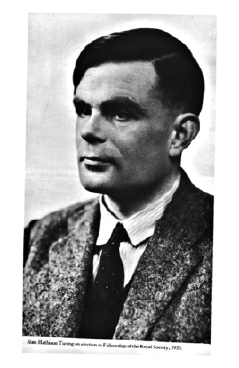
 The account below relies on the book "Alan Turing: the Enigma"
(1983) by Andrew Hodges who maintains the Alan
Turing home page.
The account below relies on the book "Alan Turing: the Enigma"
(1983) by Andrew Hodges who maintains the Alan
Turing home page.
Alan Mathison Turing was born June 23, 1912 in a nursing home in Paddington,
London to Julius Mathison and Ethel Sara Turing. His father Julius, an officer
in the British administration in India , decided that his son would be raised in
England.
Alan Turing and his older brother John had a childhood ridigly determined by
the demands of the class and the exile in India of his parents. Alan and his
brother were shuffled amongst various English foster homes as children until
their father retired from India in 1926. Alan was niether encouraged nor
supported in the foster homes and through his own pursuits found a deep
underlying passion for science, first in chemistry experiments.
As Alan became more enticed with science his mother worried that he would not
be accepted into Sherbourne,the English Public School. However, in 1926 Alan was
granted admission into Sherbourne and his mother's fears were dissolved for a
short while. Soon after his admission the Headmaster soon reported :"If he
is to be solely a scientific specialist, he is wasting his time at a public
school." In hindsight, we might say this Headmaster's assessment was almost
correct. Many other teachers also made similar
remarks.
In 1928, Turing began to study relativity. It was at this time, on the sixth
form that Alan met Christopher
Morcom; and everything changed. However, when his good friend Christopher
Morcom died in 1930, Turing was devastated, but at the same this motivated him
to do what Morcom could not.
For a couple of years following the death Alan wrote letters to Morcom's
mother questioning how the human mind , and Christopher's mind in particular,
was embodied in matter; and whether this matter was released after death. This
questioning led him to study twentieth century physics where Turing began to
wonder whether quantum mechanical theory affected his questions of mind and
matter.
On a visit to the Morcom home Turing wrote a letter stating his belief in the
survival of the spirit after death.
In 1931, Turing won a entrance scholarship at King's college in Cambridge.
Attending there as an undergraduate from 1931, Turing was encouraged to express
his ideas freely. In 1932 Turing read Von
Neumann's work on the logical foundations of Quantum mechanics. It was here,
at King's, that homosexaulity became a distinctive part of ihs identity. He
befriended a fellow undergraduate mathematician named James Atkins, who later
became his lover. For relaxation, Alan enjoyed rowing, running and later
sailing.
Turing was doing exceptionally well. He recieved his degree in 1934 followed
by a M.A. degree from King's College in 1935, and a Smith's prize in 1936 for
the work on probability theory. Turing became very interested in the problem of
computability. He wanted to find out what a computation is and whether a
computation can in fact be carried out. To answer these questions Turing
extracted from the ordinary process of computation the essential parts and
formulated these in terms of a theoretical machine, known as the Turing
machine. It has been speculated that Turing found in the concept of the
Turing machine something that satisfied the problem of the mind brought on by
Chistopher Morcom. He expanded this idea to show that there exists a "universal"
Turing machine, a machine which can calculate any number and function, given
the appropriate instructions.
In September, 1936 Turing enrolled as a graduate student at Princeton
University. His Paper, On Computable Numbers..was published near the end of
1936.This paper generated a lot of attention for him and the idea came to
mathematician John Von Neumann. Turing obtained his Ph.D thesis through work
that extended his original ideas (Ordinal Logic).
Returning to England and King's College in 1938, he was called on the
outbreak of World War II, to serve at the Government Code and Cypher School in
Bletchley Park in Buckinghamshire. It was there that Turing led in the
successful effort to crack the the German "Enigma" code, an effort
which was central in the defeat of Nazi Germany.
After the war, Turing joined the National Physical Laboratory to work on the
design of a computer.He continued his work at the University of Manchester after
1948. Turing's promising career came to a grinding halt when he was arrested
in 1952 for "gross indecency". The penalty for this crime was
submission to psychoanalysis and to horrible treatments designed to
"cure" the disease. Unfortunately, the cure proved worse than the
disease, and in a fit of depression, Turing committed suicide
in June of 1954 by eating a cyanide-poisoned apple.�
If you are interested in Theatre there is a play on Alan Turing called "Breaking
the Code" by Hugh Whitemore.
To return to the introduction page please click here.